

Facelift and Necklift
Surgical rejuvenation of the face and neck individualized to your anatomy, your aging pattern, and your vision of a natural result.
The face ages in a predictable but deeply personal way. Skin loses elasticity, fat descends from the midface into the jowls, the jawline blurs, and the neck develops laxity and banding that no skincare regimen or injectable treatment can fully reverse. For patients at a certain stage of facial aging, surgery remains the most effective and lasting solution — and the facelift, formally known as rhytidectomy, is the gold standard.
Dr. June Yoo approaches every facelift and neck lift with the same foundational belief that guides her entire practice: the goal is not to look like you had surgery. The goal is to look like a rested, rejuvenated version of yourself. Every surgical plan is built around your anatomy, your degree of aging, and what will serve your face best in the long term.
What is a Facelift?
A facelift addresses the structural changes of facial aging — lax skin, descended soft tissue, loss of jawline definition, and deepening folds — by surgically repositioning and tightening the underlying facial support structures and removing excess skin. It does not address the surface quality of skin (texture, pigmentation, fine lines) or volume loss, which may be better treated with laser resurfacing, injectables, or fat grafting either at the same time or separately.
Modern facelift surgery does not simply pull skin tighter. The most effective techniques work at the level of the deep facial support structures (the muscles, fascia, and ligaments that determine facial shape) to reposition tissue upward and medially, restoring the facial contours of youth rather than simply smoothing surface skin. The result is a more natural, longer-lasting rejuvenation that avoids the pulled, windswept appearance associated with outdated approaches.
What is a Neck Lift?
A neck lift targets the aging changes specific to the neck: excess skin laxity, submental fat accumulation, and the vertical banding of the platysma muscle that creates the characteristic "turkey neck" or "necklace lines" of facial aging. It may be performed as a standalone procedure for patients whose primary concern is the neck alone, or more commonly, in combination with a facelift, since the face and neck age as a connected anatomic unit.
Neck lift surgery typically involves a combination of: direct excision of excess skin through well-concealed incisions; liposuction or direct fat removal from the submental region when indicated; and platysmaplasty — surgical tightening and repositioning of the platysma muscle to restore a cleaner, more defined cervicomental (chin/neck) angle.


Facelift Techniques
Facelift technique selection is one of the most important decisions in facial plastic surgery, and the right choice depends on your individual anatomy, degree of aging, skin quality, and goals. Dr. Yoo will evaluate your face comprehensively and recommend the approach most likely to produce the most natural and durable result for you.
-
The superficial musculoaponeurotic system, or SMAS, is the fibromuscular layer lying beneath the facial skin that provides the structural foundation of the face. SMAS-based facelift techniques work at this layer — lifting and repositioning it to restore facial structure and support the overlying skin.
Several SMAS approaches exist, ranging from SMAS plication (folding and suturing the SMAS without detaching it) to SMASectomy (partial excision of the SMAS) to full SMAS dissection and flap elevation. The choice among these depends on the degree of facial sagging, skin quality, and the patient's facial proportions. SMAS plication carries a lower hematoma risk than deeper dissection techniques and is well-suited for patients with moderate facial laxity. More extensive SMAS dissection offers greater correction of deeper facial descent at the cost of a modestly elevated complication profile.
-
The deep plane technique extends the dissection beneath the SMAS into a deeper facial plane, releasing the key ligaments that tether the descended facial tissues and allowing them to be repositioned more completely and more naturally. By addressing the deeper support structures rather than relying on skin tension alone, the deep plane facelift produces results that are widely regarded as more natural in appearance, more comprehensive in correction, and more durable over time. It does carry a modestly higher overall complication rate and hematoma risk compared to SMAS plication, reflecting the more extensive dissection involved. In expert hands, these risks are carefully managed through meticulous technique and perioperative protocols.
Dr. Yoo will discuss which approach is most appropriate for your anatomy and degree of aging during your consultation.
Neck Lift in Detail
Platysmaplasty
The platysma is a paired flat muscle that spans the front of the neck. With aging, the medial edges of the two platysmal bands separate and become visible as vertical cords beneath the skin — one of the most recognizable signs of neck aging. Platysmaplasty refers to surgical repair of these bands, which may involve suturing the medial edges together in the midline (corset or anterior platysmaplasty), partial myotomy to release persistent banding, or a combination of approaches depending on the anatomy.
Open anterior platysmaplasty, while highly effective for midline neck banding, does carry a higher perioperative hematoma risk than facelift alone. Dr. Yoo accounts for this in her surgical planning and takes specific intraoperative precautions to minimize bleeding risk.
Submental Fat Management
Excess fat beneath the chin and in the submental region can contribute significantly to loss of neck definition and an ill-defined cervicomental angle. This fat is addressed through direct excision or liposuction, performed through a small incision placed in the natural crease beneath the chin. Fat removal is approached conservatively — over-resection leads to a skeletonized, unnatural neck appearance that is both aesthetically unsatisfying and difficult to correct secondarily.
Cervicomental Angle
A well-defined cervicomental angle — the angle between the chin and neck — is one of the hallmarks of a youthful neck. Restoring this angle through a combination of submental fat management, platysmaplasty, and skin repositioning is the primary goal of neck lift surgery.
Facelift and neck lift incisions are carefully planned to follow and hide within natural anatomic boundaries:
The primary facelift incision begins in the temporal hairline, follows the natural contour in front of the ear, wraps around the earlobe, and continues behind the ear into the occipital hairline. Incision design is tailored to your hairline position and ear anatomy to ensure natural-looking results without hairline distortion.
A small submental incision — placed within the natural crease beneath the chin — also may be used depending on the patient’s needs.
Dr. Yoo takes great care in incision closure to produce the finest possible scar — but scars are permanent, and their final appearance continues to improve over twelve to eighteen months.
Incisions and Scars
What a Facelift Cannot Do
Understanding the limits of facelift surgery is as important as understanding what it can achieve. A facelift is a structural procedure — it addresses laxity, descent, and loss of definition. It does not:
Significantly improve skin surface quality, texture, or pigmentation (these are better addressed with laser resurfacing or chemical peels)
Restore volume lost from the midface, temples, or lips (addressed with fat grafting or fillers)
Lift the brows or upper eyelids (addressed with a brow lift or blepharoplasty)
Permanently stop the aging process
Many patients benefit from a combination approach — pairing a facelift with complementary procedures such as brow lift, blepharoplasty, fat grafting, or skin resurfacing to address all dimensions of facial aging comprehensively. Dr. Yoo will discuss which combination is most appropriate for your goals during your consultation.
Am I a Good Candidate?
You may be a good candidate for facelift and/or neck lift surgery if you:
Notice jowling or loss of jawline definition that concerns you
Have significant skin laxity in the lower face or neck
Have visible platysmal banding or excess submental fat
Are in good overall health with no uncontrolled systemic conditions
Are a non-smoker or willing to cease smoking well in advance of surgery (smoking significantly impairs wound healing and increases complication risk)
Are at a stable, healthy weight as significant weight changes after surgery can alter results
Have realistic expectations for a natural, proportional rejuvenation
Facelift surgery is most commonly performed in patients between their 40s and 70s, though candidacy is determined by anatomy and degree of aging rather than age alone.
Recovery & Results
Facelift and neck lift surgery is performed under general anesthesia on an outpatient basis, typically taking three to five hours depending on the scope of the procedure. Drain tubes are routinely placed and removed within one to two days at a follow-up visit.
In the first week, swelling, bruising, and tightness are expected and well-managed with prescribed medication. Most patients are comfortable moving around within one to two days, and return to light, non-public activity within two weeks. Most patients are ready to be seen in social settings by two to three weeks, when the majority of swelling and bruising has resolved. Strenuous activity and anything that significantly elevates blood pressure should be avoided for three to four weeks.
Numbness in the facial skin and around the earlobe is common following facelift surgery. Sensation in most areas recovers gradually over weeks to months. Numbness of the earlobe specifically — related to the great auricular nerve, which runs in close proximity to the surgical field — can persist longer and is disclosed as a recognized risk during the consent process.
Final results continue to refine over three to six months as swelling resolves and tissues settle. Results from modern facelift surgery are long-lasting and most patients enjoy their outcome for seven to ten years before natural aging prompts consideration of a secondary procedure, though individual variation is significant.

Your consultation with Dr. Yoo
Your facelift consultation at June Plastic Surgery is a thorough, meaningful evaluation. Dr. Yoo will assess your facial anatomy, degree of tissue descent, skin quality, and volume distribution, and discuss your goals in detail. She will be transparent about what each technique can and cannot achieve, and about the recovery and risk profile associated with the approach she recommends.
Key decisions you'll make together include:
Facelift technique based on anatomy and degree of aging
Whether neck lift components are indicated (platysmaplasty, submental fat management)
Whether complementary procedures are appropriate (brow lift, blepharoplasty, fat grafting, skin resurfacing)
Surgical sequencing if multiple procedures are planned
Frequently Asked Questions
-
Yes, when performed with modern technique and thoughtful planning, facelift results should look refreshed and natural, not operated on. The key is working at the level of the deep facial structures rather than relying on excessive skin tension. Dr. Yoo's approach prioritizes restoring facial anatomy to a more youthful position rather than simply pulling skin tight.
-
A mini facelift uses shorter incisions and more limited dissection to address mild to moderate lower face laxity. It has a shorter recovery and lower complication profile, but produces less correction and less durable results than a full facelift. It may be appropriate for younger patients with early laxity. Dr. Yoo will discuss whether a full or limited procedure is better suited to your anatomy during consultation.
-
Modern facelift results typically last seven to ten years, though this varies significantly based on genetics, lifestyle, sun exposure, and weight stability. The aging process continues after surgery, but patients who have had a facelift consistently look younger than they would have without one at the same point in time.
-
Yes. Facelift is commonly combined with neck lift, brow lift, blepharoplasty, fat grafting, and skin resurfacing procedures. Combining procedures under a single anesthetic reduces overall recovery time compared to staging them separately. Dr. Yoo will assess whether combination surgery is safe and appropriate based on your health and the scope of what is planned.
-
The most common complication requiring surgical intervention is hematoma — a collection of blood beneath the skin — occurring in approximately 1.8 to 2% of facelift cases. A rapidly expanding hematoma is a surgical emergency and is managed with prompt return to the operating room. Facial nerve injury is uncommon but a recognized risk; the marginal mandibular nerve, which controls lower lip movement, is the most commonly affected motor branch. The great auricular nerve, a sensory nerve supplying the earlobe and lower ear, is the most commonly affected sensory nerve. Infection rates are low, ranging from 0.2 to 0.9% in published series. All risks will be reviewed in full during your informed consent discussion.
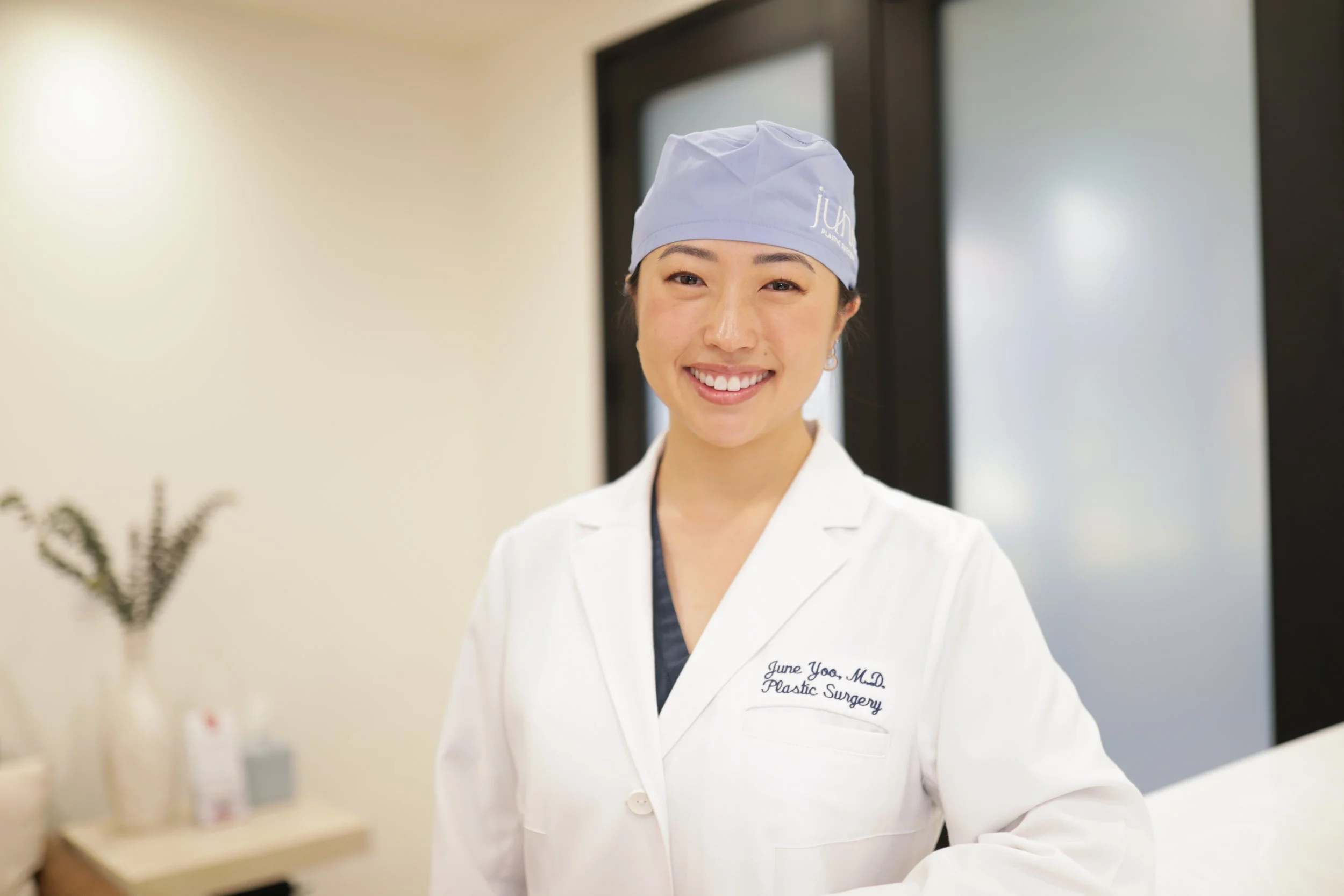
A face that reflects how you feel: refreshed, defined, and unmistakably you.
Dr. June Yoo brings surgical precision, a thorough understanding of facial anatomy, and a commitment to natural outcomes to every facelift and neck lift she performs. If facial aging has been on your mind, we invite you to schedule a consultation and take the first step toward a result you will feel confident in for years to come.