

Breast Cancer Reconstruction
Primary and revision breast reconstruction individualized to your diagnosis, your oncologic treatment plan, your anatomy, and your vision of what comes next.
A breast cancer diagnosis changes everything, and the path through it is different for every woman. For many, the decision to pursue breast reconstruction is part of reclaiming a sense of wholeness after mastectomy or lumpectomy. It is not a decision that needs to be rushed, and it is not a decision that needs to be made at all. But for those who do choose reconstruction, the quality, timing, and type of that reconstruction matters profoundly for the long-term physical result, for quality of life, and for the ability to move forward.
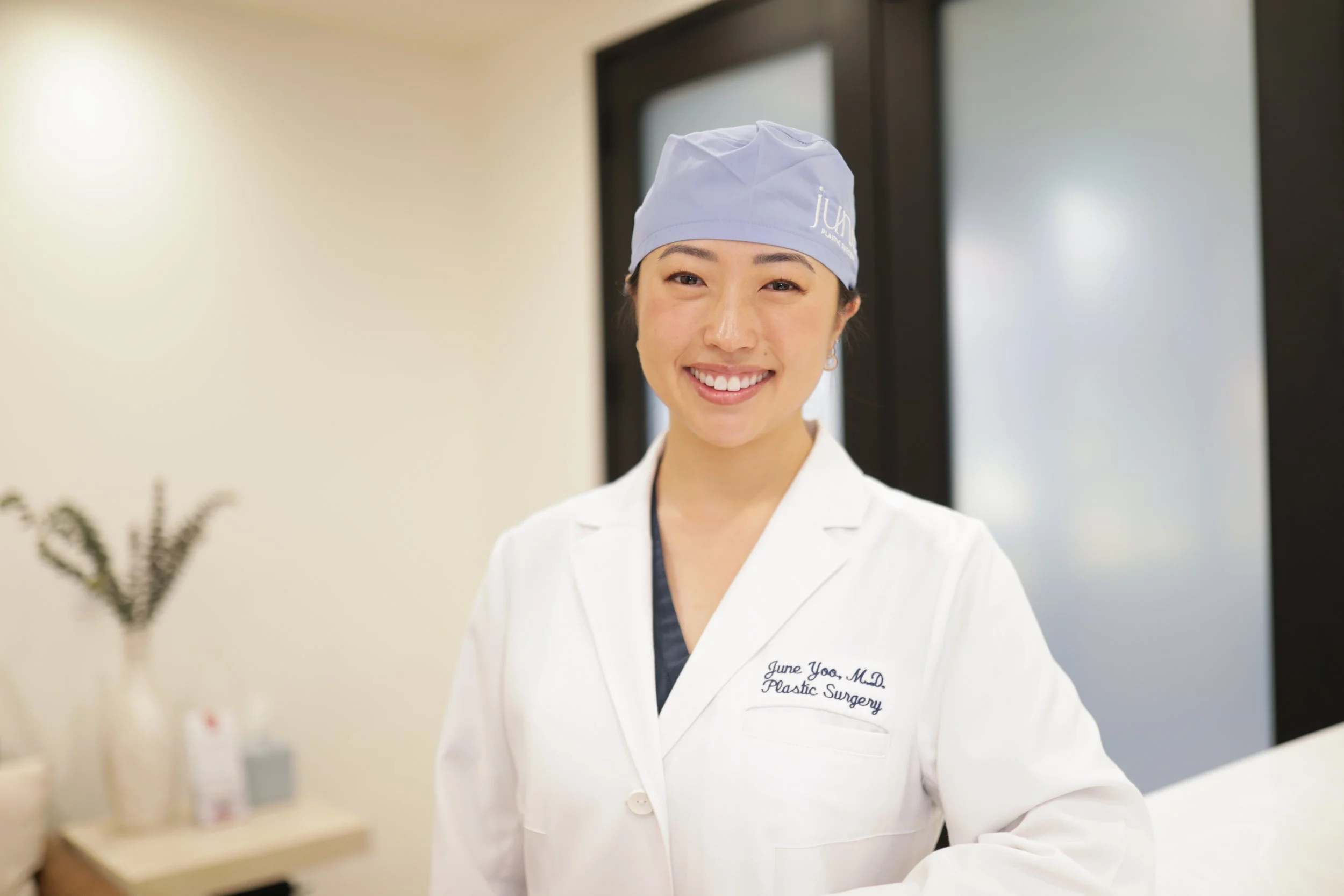
Dr. June Yoo brings deep expertise in both implant-based and hybrid-autologous breast reconstruction to every patient she cares for. Her role is not to recommend a single approach, it is to ensure that you understand all of your options, that your reconstruction is planned in close coordination with your oncologic team, and that the final result reflects the outcome you envisioned.
Breast reconstruction is not a luxury. Under federal law, it is a covered benefit — and understanding your rights is one of the first things Dr. Yoo's team will help you with.
Your Rights Under Federal Law
The Women's Health and Cancer Rights Act (WHCRA) of 1998 is federal legislation that requires most group health insurance plans covering mastectomy to also cover all stages of breast reconstruction — including:
Reconstruction of the breast on which mastectomy was performed
Surgery and reconstruction of the opposite breast to produce a symmetrical appearance
Prostheses and treatment of physical complications at all stages, including lymphedema
Revisions to the reconstructed breast, regardless of when they occur relative to the original surgery
Critically, coverage cannot be denied based on how much time has passed since the mastectomy, and reconstruction can be pursued at any point: immediately at the time of mastectomy or years later. Coverage also extends to patients who had their mastectomy under a different insurance plan, and is not limited to patients with a cancer diagnosis. Patients undergoing prophylactic mastectomy for high-risk gene mutations (including BRCA1 and BRCA2) also have reconstruction rights under the WHCRA.
Dr. Yoo's office will work directly with your insurance to verify your reconstruction benefits and navigate the prior authorization process before your surgery.
One of the first decisions in reconstruction planning is timing, and there is no universally correct answer. The right timing depends on your oncologic treatment plan, your risk factors, and your personal preferences.
Immediate reconstruction is performed at the same time as mastectomy, in a coordinated surgery with your breast surgical oncologist. It has the advantages of avoiding a second anesthetic exposure and surgical episode, preserving the natural skin envelope of the breast, and allowing reconstruction to begin before the psychological impact of post-mastectomy appearance takes hold. Most patients who are appropriate candidates for immediate reconstruction.
Delayed reconstruction is performed as a separate surgery, weeks, months, or even years after mastectomy. It may be the preferred approach when the oncologic plan includes radiation. Delayed reconstruction is also appropriate for patients who need time to complete chemotherapy, recover from initial surgery, or simply feel ready to pursue reconstruction on their own timeline.
Delayed-immediate reconstruction is a staged approach in which a tissue expander is placed at the time of mastectomy to preserve the skin envelope, and definitive reconstruction is performed after oncologic treatment is complete. This approach is commonly used when the need for radiation is uncertain at the time of mastectomy.
The decision between immediate and delayed reconstruction is made collaboratively between Dr. Yoo, your breast surgical oncologist, and your medical and radiation oncologists based on your complete oncologic picture.
Reconstruction by Anatomic Immediate vs. Delayed Reconstruction


Implant-Based Breast Reconstruction
Implant-based breast reconstruction (IBBR) is the most commonly performed reconstructive approach in the United States, accounting for the majority of post-mastectomy reconstructions performed annually. It involves restoring breast volume using a silicone or saline implant, either in one or two surgical stages.
Two-Stage Reconstruction: Tissue Expander Followed by Implant Exchange
The most common implant-based approach involves placing a tissue expander at the time of mastectomy as the first stage, followed by gradual expansion over several weeks to months, and then a second surgery to exchange the expander for a permanent implant.
This approach allows the skin and soft tissue to be gradually stretched to accommodate the desired volume, and provides the flexibility to complete expansion before deciding on final implant size. It also allows for adjustment of the reconstructive plan if post-mastectomy radiation is ultimately required.
Direct-to-Implant Reconstruction
In carefully selected patients, particularly those with excellent mastectomy skin flap perfusion, adequate skin envelope, and no anticipated need for radiation, a permanent implant can be placed at the time of mastectomy in a single surgical stage, eliminating the need for a second procedure. Patient selection is critical, as direct-to-implant reconstruction is less forgiving of skin flap compromise than the two-stage approach.
Prepectoral vs. Subpectoral Implant Placement
One of the most significant technical decisions in implant-based reconstruction is the plane of implant placement:
Subpectoral (under the muscle) placement has been the traditional approach for decades, providing additional soft tissue coverage over the implant. It does, however, require elevation of the pectoralis major muscle, which is associated with postoperative pain, animation deformity (visible implant movement with muscle contraction), and potential shoulder girdle morbidity.
Prepectoral (above the muscle) placement, supported by acellular dermal matrix (ADM) or synthetic mesh, places the implant entirely in front of the pectoralis — preserving the muscle completely. Published comparative data demonstrate that prepectoral reconstruction is associated with reduced postoperative pain, shorter time to complete expansion, and less animation deformity compared to subpectoral placement, with comparable complication rates in appropriately selected patients.
Prepectoral placement requires sufficient mastectomy skin flap thickness and perfusion. It may not be appropriate for all patients, and the final decision is made after careful intraoperative assessment.
Post-Mastectomy Radiation Therapy and Implant Reconstruction
Radiation significantly increases the complication rate of implant-based breast reconstruction. This includes capsular contracture, wound healing problems, implant exposure, and reconstruction failure. When post-mastectomy radiation therapy is anticipated or required, the timing and sequencing of reconstruction require careful planning. Options include performing radiation during the expander phase and exchanging to the permanent implant after completion, or considering a switch to autologous reconstruction after radiation is complete.

Autologous Breast Reconstruction
Autologous reconstruction uses the patient's own tissue to reconstruct the breast. It produces a breast that is composed entirely of living tissue, feels natural, ages naturally with the body, and is not subject to the complications of a foreign implant.
The primary trade-off is complexity as autologous reconstruction involves a longer surgery, a longer recovery, and a donor site scar in addition to the breast scar. It is not appropriate for every patient. The decision between autologous and implant-based reconstruction requires a candid discussion of your anatomy, your oncologic plan, your lifestyle, your donor site preferences, and your goals for the reconstructed breast.
DIEP Flap (Deep Inferior Epigastric Perforator Flap)
The DIEP flap is the most widely performed perforator-based autologous breast reconstruction technique and is considered among the preferred approaches for abdominal flap reconstruction. The DIEP flap harvests skin and fat from the lower abdomen which is transferred to the chest as a free flap, with its blood supply reconnected microsurgically to vessels in the chest using microsurgical anastomosis.
Latissimus Dorsi Flap
The latissimus dorsi (LD) flap uses skin, fat and muscle from the upper back, rotated through the axilla and onto the chest, usually over an implant. The volume from the back in addition to a small implant underneath can really not only look like a breast, but feel warm in temperature and soft like a natural breast. This is Dr Yoo’s preferred technique for autologous breast reconstruction.
Revision Breast Reconstruction
Breast reconstruction is rarely a single event. Most patients benefit from one or more revisional procedures to refine the reconstructed breast, address asymmetry, or improve the overall aesthetic result. Revisions are a standard and expected part of the reconstruction journey, and under the WHCRA, they are covered by insurance.
-
Autologous fat grafting — harvesting fat from one area of the body and transferring it to the reconstructed breast — is one of the most valuable tools in breast reconstruction revision. It can be used to:
Soften implant edges or rippling
Improve upper pole fullness and contour irregularities
Address skin irregularities, dimpling, and radiation changes
Augment volume in autologous flap reconstructions
Restore contour at the donor site
The ASPS supports fat grafting as a medically appropriate component of reconstructive surgery, not an experimental procedure. Multiple sessions may be required to achieve the desired volume and contour.
-
The WHCRA explicitly mandates insurance coverage for surgery on the opposite (non-operated) breast to achieve symmetry with the reconstructed side. Depending on the natural breast's size, shape, and degree of ptosis, this may involve breast reduction, breast lift, or breast augmentation of the opposite breast. Achieving the best possible symmetry between the reconstructed and natural breast is a priority of Dr. Yoo's reconstructive approach and is a standard component of the multistage reconstruction plan.
-
Capsular contracture — thickening and tightening of the scar tissue around a breast implant — is the most common complication of implant-based breast reconstruction, occurring at higher rates in the setting of radiation. Grades III and IV contracture typically require surgical intervention: capsulotomy (releasing the capsule) or capsulectomy (removing it), with or without implant exchange. When contracture is severe or recurrent, conversion to autologous reconstruction may be the most durable long-term solution.
-
Reconstruction of the nipple-areolar complex (NAC) is the final stage of breast reconstruction and is covered under the WHCRA.
Am I a Good Candidate?
You may be a candidate for breast reconstruction if you:
Are planning or have undergone mastectomy (therapeutic or prophylactic) or lumpectomy
Have completed, or have a clear plan for, oncologic treatment
Are in good overall health appropriate for the planned surgical approach
Have realistic expectations for a staged reconstructive process with multiple steps
Wish to restore a sense of physical wholeness and symmetry after breast cancer treatment
There is no expiration on reconstruction. Women who had mastectomies years or even decades ago and never pursued reconstruction — or who had a prior reconstruction they wish to revise — are candidates for consultation at any time.

Your consultation with Dr. Yoo
Your breast reconstruction consultation is among the most meaningful conversations Dr. Yoo has with any patient. She will review your complete surgical and oncologic history, evaluate your anatomy and donor site options, discuss your goals and your oncologic treatment timeline, and present the full range of options available to you.
Key decisions you will make together include:
Timing — immediate, delayed-immediate, or delayed reconstruction
Reconstructive approach — implant-based, autologous, or combination
Implant placement plane if implant-based — prepectoral vs. subpectoral
Radiation sequencing — how your oncologic treatment plan affects the reconstructive approach
Staged plan — how many procedures are anticipated, in what order, and on what timeline
Symmetry procedure on the opposite breast — whether and when
Frequently Asked Questions
-
Yes — for most patients. The Women's Health and Cancer Rights Act of 1998 requires most group health insurance plans that cover mastectomy to also cover all stages of breast reconstruction, surgery on the opposite breast for symmetry, and revisions at any point. There is no time limit on when reconstruction must be initiated. Medicare and Medicaid operate under separate rules, and individual plan details vary — Dr. Yoo's team will help verify your specific benefits before surgery.
-
Yes, but radiation significantly affects reconstructive planning and outcomes — particularly for implant-based reconstruction. Radiation increases capsular contracture rates and overall complication risk when delivered to an implant reconstruction. Autologous reconstruction is more durable in the irradiated field. The timing and sequencing of radiation relative to reconstruction is one of the most important planning conversations Dr. Yoo will have with you and your oncologic team.
-
Revision reconstruction is covered under the WHCRA at any point after mastectomy, regardless of when the original reconstruction was performed or what insurer covered it. Whether you wish to address capsular contracture, improve symmetry, convert from implant to autologous reconstruction, or refine your NAC, a consultation is the appropriate first step.
-
Yes, insurance should cover contralateral (other side) breast surgery for symmetry.
-
Recovery timelines vary significantly depending on the reconstructive approach. For implant based breast reconstruction, most patients recover within 2 weeks and return to normal activity by 4-6 weeks. For autologous procedures, this may require a few days in the hospital, back to light activity 3-4 weeks, and full activity 6-8 weeks.
Rebuilding. Restoring. Feeling more like yourself, on your terms.
Breast reconstruction is among the most meaningful work Dr. June Yoo performs as a surgeon. She understands that the decision to pursue reconstruction and choice of reconstruction is deeply personal, shaped by your relationship with your body, your cancer experience, and your vision of what wholeness means to you. Whatever that vision is, she is here to help you achieve it.
We invite you to schedule a consultation at our Newport Beach office. Your reconstructive journey begins with a conversation — and Dr Yoo will be there to guide you every step of the way.